

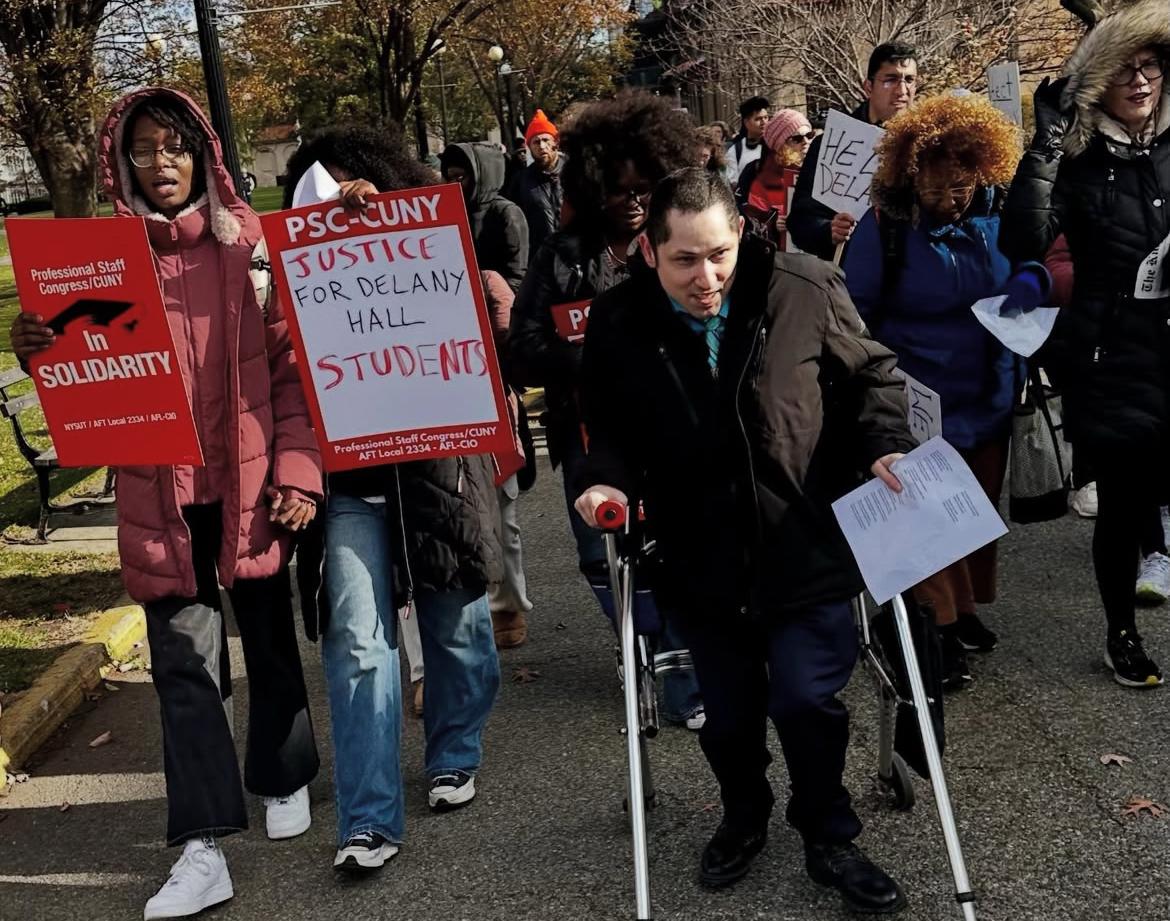

“QUEENS COLLEGE IS TOXIC,” read the fliers posted across campus by members of the Professional Staff Congress (PSC), a CUNY union that serves over 30,000 CUNY faculty and staff. On Monday, November 17th, members of the PSC organized a march at the flagpole behind Jefferson Hall to protest the Queens College administration’s mismanagement of the construction at Delany Hall.
The goal of the Delany Hall Envelope Project, a construction project, is to replace the exterior of the building with environmentally friendly materials, replace the windows and address asbestos in the building. The construction, which started on Friday, May 30th, has since left faculty and students displaced over the health and safety issues caused by the renovations.
One week prior to the march, the Queens College PSC chapter had announced on their Instagram page that over 1,100 signatures of their petition to demand health and safety protections for faculty in Delany Hall were delivered to President Frank H. Wu’s office on the 12th floor of Kiely Hall.
“President Wu refused to speak to us, instead locking his door and sending 4 security officers to greet us, and a surrogate to accept the petition,” said the PSC in their November 11th Instagram post.
Protestors held up signs reading “Student Health Matters,” “Respect Health & Safety,” and “Justice for Delany Hall,” as they chanted, “An injury to one is an injury to all. It’s time to clean Delany Hall.”
At the end of the protest, faculty members with offices inside Delany Hall provided testimonies about their experiences throughout the duration of the construction project. The gathering was located in front of the east entrance of Kiely Hall, which houses the offices of the Queens College administration.
“We got the report that the air was ‘within standard.’ So, within standard means what? That means the bare minimum,” said Dr. Walter Lucken IV. “I have never met anyone who works for the SEEK Program or works in Delany Hall who does their work ‘within standard’ as in the bare minimum.”
He continued, “I don’t know what the correct standard is for all this. I don’t know about particulate matter. That’s not what I went to school for. However, I do know the correct amount of toxic silica dust in my colleagues’ offices, on their desks, which is what? Zero. The correct amount of medical appointments, missed work, lung inflammation, whatever is going on, the correct amount of all of that is what? Zero.”
According to the Center for Disease Control & Prevention (CDC), silica is a compound of oxygen and silicon naturally found in the environment, in particles too large to impact humans. However, silica in air as a result of construction is small enough to breathe in and damage the respiratory system. Exposure to silica for long periods of time has been linked to lung cancer, chronic obstructive pulmonary disease (COPD), kidney failure, autoimmune disease, and increased risk of tuberculosis.
Asbestos, a classification of durable fibers often used in construction in the 1970s, can lead to irritation of the lungs if tiny particles are inhaled. Asbestos-related diseases, including cancer, develop years after initial exposure.
“I started the summer program, and two days in I was having a lot of headaches,” said Valandie Seide, a Psychology major and a student in the SEEK program in an interview with The Knight News. “I’m anemic, so I thought it was my iron deficiency… So because of those headaches I spent time like laying my head down in the Student Union and when I went to the doctor after the program ended, they said that my iron like had nothing to do with it, my iron is great.”
Erica Doran, the Queens College PSC Chapter Chair, said this:
“Where the faculty and the students have been left abandoned by this administration to fend for themselves, it is an abomination, and they know. I have met with them. They won’t come out and publicly say anything but they’ve been in that building. They have to know.”
In an interview with The Knight News, Doran said, “We have an organization through PSC Central, the Health and Safety Watchdogs, who showed up and they have been doing some walkthroughs…They were the ones who first brought to my attention that they were not following proper Asbestos Abatement protocols — the proper screening devices, the guards were not where they should be, that this was a problem.”
Among the attendees that testified was William “Bill” Modeste, a highly respected figure in New York City basketball. He began working for the SEEK Program as a counselor in 1968, two years after the program was founded.
Referring to the SEEK Program, he said, “It has done some remarkable things. I look around the campus and I see the buildings that we used to occupy are now parking lots. It seems as if the college has never really accepted our existence or appreciated our being here. But, the struggle continues and our motto is ‘learn to struggle and struggle to learn.’”






[…] am writing in response to the article, “Dust in Delany Hall: CUNY Union Fights Back,” that appeared online in the Knight News on December 9, 2025. In the interest of […]