

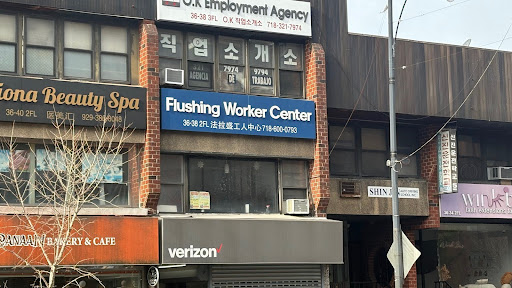

On October 8th, participants from the Ain’t I a Woman?! (AIW) campaign and the Flushing Workers Center (FWC) rallied in front of The Shirley A. Chisholm State Office Building demanding Governor Hochul to reopen wage theft cases, stop giving money to the Chinese-American Planning Council (CPC) and denounce the 24-hour workday.
“We ask Governor Hochul and we ask our DOL commissioner to please do what’s right, support these workers and make sure they get paid every penny that they have earned,” Senator Jessica Ramos, Chair of the New York State Senate Labor Committee, said during the rally. “No one should be forced to work 24 hours, and if you work, you should be paid for every single minute of labor that you’ve performed.”
In November 2014, Lai Yee Chan, a former home care worker, received a check of $200 from the Department of Labor (DOL) after they found that the CPC owed home care workers overtime. The check that Lai Yee Chan received was meant to compensate her for 6,000 hours she worked between 2007 and 2013. That’s when Lai Yee Chan started talking to other home care workers and complaining to her union about their unpaid overtime. The union claimed that CPC did not have to pay her for overtime because CPC is a non-profit organization.
Since 2015, home care workers — who help the elderly, disabled and those with chronic illness in their daily lives — have been organizing for their stolen wages after being paid for only 13 hours of their 24 hour shifts. That’s $7.50 per hour, which is less than half of New York State’s current minimum wage of $16.50 per hour.
According to Title 29 of the Code of Federal Regulations (CFR) section 285.22 (2025), when an employee is required to be on duty for 24 hours or more, they must be allowed a sleeping period of at least 5 hours. If that sleeping period is interrupted and the employee can’t get a reasonable amount of rest, the employee must be paid for 24 hours of labor.
“My first patient had many illnesses. The person in charge of the assignment told me I had to turn her body over every 90 minutes every night,” said Mei Kum Chu, who worked 24-hour workdays for 10 years, in a testimonial on the No More 24! website. “The second patient also needed 24-hour care. I was unable to sleep because she called for me every 1 to 2 hours. Because I could not get proper sleep at night, and got busy and tired, I slipped in the shower and was injured.”
The CPC has been employing home care workers through the Chinese-American Planning Council Home Attendant Program Inc. (CPCHAP), the subsidiary of the CPC, since 1983. The CPCHAP currently serves 2500 patients and employs 4500 home care workers, 80 of which are assigned to 24-hour shifts.
The AIW campaign was started by a group of garment workers in 1991 that were organizing for better working conditions in sweatshops. In addition to the rally on October 8th, the AIW campaign organized the hunger strike outside of City Hall in March 2024 and organized pickets in front of CPC’s headquarters demanding that they pay back stolen wages.
The FWC has been organizing for better working conditions and advocating for their communities since 2014. Along with organizing for the “no more 24” campaign, the FWC has also been organizing to oppose the building of a casino in Flushing.
“We must end this cycle of violence. We must end this system of long workdays,” states a zine made by the “no more 24” campaign in 2024, “and it’s on you, me, and all of us.”