

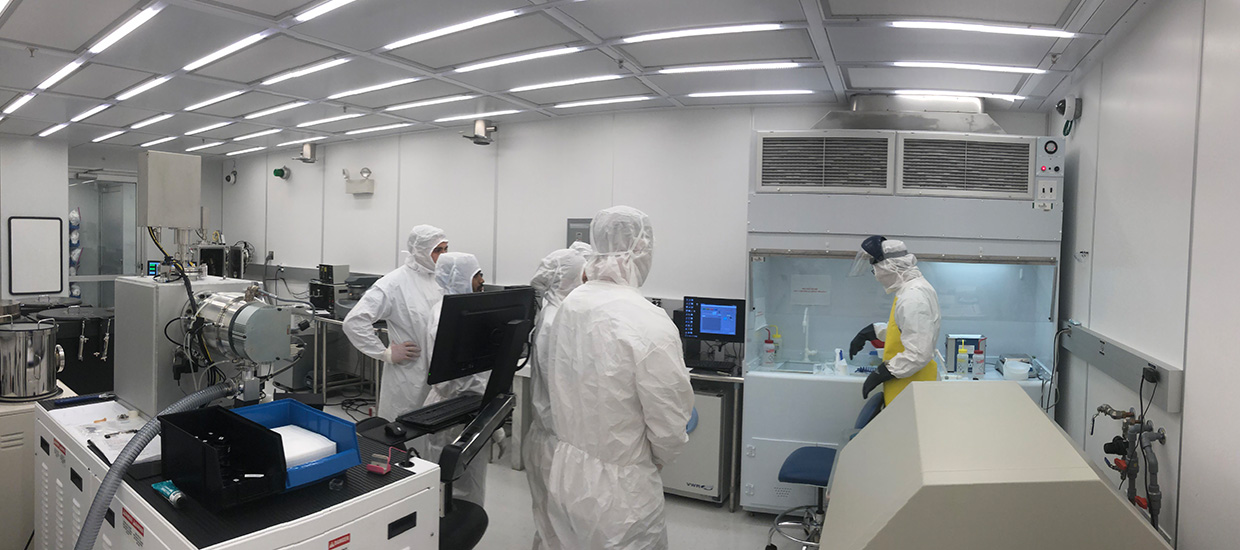

Queens College is currently working toward building the borough’s first nanofabrication facility, or “cleanroom,” for student use. Such facilities use state-of-the-art technology to create controlled environments for sophisticated micro-engineering.
The facility is one of three student-focused STEM projects receiving over $3 million in federal funding secured by U.S. Representative Grace Meng and U.S. Senator Kirsten Gillibrand. Over $1 million of that will fund the technology, equipment and personnel for the new cleanroom, which will be based out of QC’s Physics Department. The estimated completion date for this facility is Fall 2028, according to QC Physics Assistant Professor Euclides Almeida.
“The Queens College nanofabrication facility — or ‘cleanroom’ — would place us at the forefront of research and workforce development in the borough of Queens and makes us competitive with other top colleges in New York City and beyond,” said QC President Frank H. Wu to The Knight News.
The facility will allow students and researchers to design and build advanced prototypes directly on campus, increasing research activity and strengthening collaborations with New York City-based technology companies. Research areas that rely on nanofabrication at QC include semiconductors, laser technology, solar energy and the development of next-generation cancer sensors.
“It is critical that Queens College undergraduates are exposed to and trained in state-of-the-art technologies… Despite the high-tech nature of the program, the principles underlying nanofabrication would be within the reach of undergraduates in a number of STEM majors,” Wu said.
Assistant Professor Euclides Almeida, a physicist specializing in experimental nanophotonics and metamaterials, offered a glimpse into what students will encounter when the facility opens in an interview with The Knight News.
“They will see a gowning area where they have to be properly dressed in order to avoid contamination of the cleanroom,” Almeida stated. “They will see equipment for lithography, deposition, etching. They will see vacuum systems, yellow room for photolithography, fume hoods for chemical processing, and equipment for metrology.”
For students in Almeida’s hands-on courses like the Photonics Laboratory, the cleanroom represents a shift from abstract concepts to tangible experience.
Almeida further explained, “It will provide a deeper hands on experience… A really immersive experience right on campus, so we can actually go deeper into topics so it won’t just be an abstract idea. You will be able to touch and see and compare the theory with the practice.”
The facility also positions QC students competitively in a job market looking for nanofabrication skills.
Almeida pointed to a former student now working at TRUMPF Photonics, a company that makes high-powered lasers for manufacturing:
“Many of our graduates took positions in the industry. So there’s an example of a student who is working at TRUMPF Photonics… She is working as a process failure analysis engineer doing microscopic images of photonics elements. She worked with me doing some imaging here, so she got the hands-on experience.”
Almeida detailed how this facility will compare to those at other institutions with the following:
“This will be on the level of the top research institutions…Like Cornell, Harvard, MIT. They all have these nanofabs, so students won’t be behind in terms of skills that they will learn.”
Nanofabrication is the set of technologies used to build extremely small devices with features up to 100,000 times thinner than the width of a human hair. The technological process must be done in extraordinarily clean environments because it works at such a small scale.
The QC facility will be a Class 1000 cleanroom, meaning it removes more than 99.9 percent of airborne particles—preventing any potential interference with device fabrication.
Wu emphasized that the facility sends a message about accessibility:
“The establishment of the Queens College nanofabrication facility would make clear that an affordable education does not in any way limit Queens College students’ access to training in cutting edge technology and career opportunities in STEM… The nanofabrication facility would further strengthen our connection to the local community, enhancing Queens College’s role as an engine of economic growth and upward mobility.”
For students considering physics, engineering or related fields, Almeida offered this advice:
“Be curious, train your creativity, try to have a broad knowledge in physics. Try to search for career opportunities and make the most out of your undergraduate experience at Queens College. If you’re eager to learn, that’s basically all you need.”