

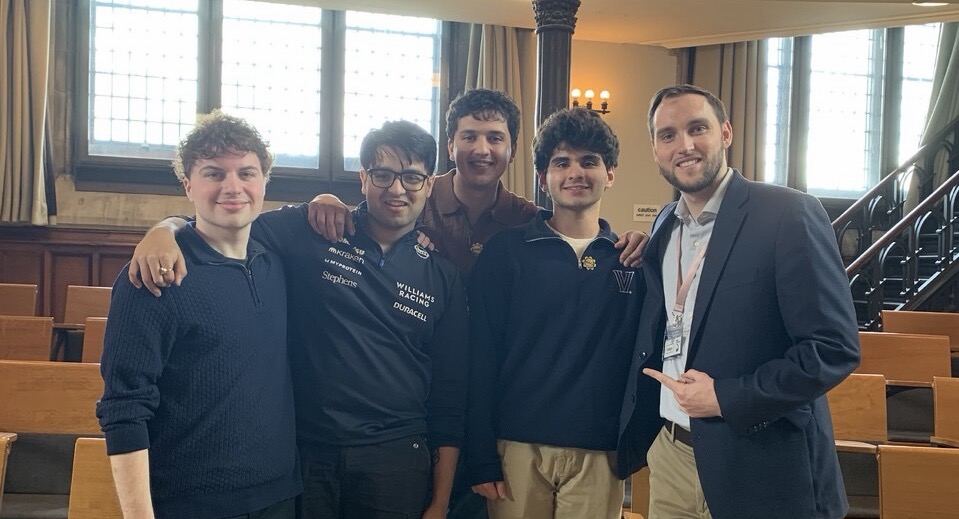

Like pythons, this Queens College student and his team of coders slithered their way to the top and scored a major win at HackPrinceton spring 2026.
Hosted at Ivy League University, Princeton Saiyid Gilani – a sophomore computer science student at QC – along with his team placed first in HackPrinceton, one of the biggest hack-a-thons in the country.
Their group, Asclepius placed first amongst 400 people in more than 100 teams with special recognition in both the Regeneron Health Track as well as the D1 Lab AI Research and Alignment Track. Gilani’s team was the only group to win overall and within two tracks.
Gilani’s teammates comprised three other student-coders, Brandon McGuckin, a Computer Science student from Ohio State University, Shivam Arrora, a Computer Science and Engineering student from Villanova University and Shashwat Raj, a Computer Science and Math student from Arizona State University. All group members met for the first time on the day of the event and worked their way to success.
“The environment had this electric mix of pressure and excitement …whiteboards covered in diagrams, teams huddled in corners debugging until sunrise, and mentors floating around offering feedback. There was a real sense of teamwork. People genuinely wanted to see each other’s projects succeed, and conversations between teams often turned into idea exchanges rather than rivalries,” stated Gilani.
With their project titled Neutral-Guided Semantic Proxy (NGSP), the group focused on healthcare institutions such as hospitals, clinical trial teams and research teams wanting to use Language Learning Models (LLM’s) like ChatGPT on sensitive data. This raises serious privacy and compliance concerns with anonymity of patients’ data and health records.
One option could be to block LLM’s entirely. However, this would not work if healthcare professionals continue to input patient data into AI systems with the hopes that nothing leaks.
“The default response to ‘people are putting patient data into ChatGPT’ is to write another policy, and policies clearly aren’t stopping it. We treated it as a systems problem. People are going to use powerful tools regardless of restrictions, so we designed something that makes the behavior safer instead of pretending it isn’t happening,” said Gilani.
The main goal of the team’s NGSP model was for it to act as an intermediary between the user and an AI system; cleaning, sanitizing and transforming the data before it reaches external systems like LLM’s. This allows institutions to take advantage of these tools without putting sensitive information at risk.
The Knight News reached out to Gilani regarding the process of building the model. “For this project specifically, we spent about 30 of the 36 hours on research and prototyping, trying different architectures, poking holes in them and refining; the last chunk actually building. Sounds backwards, but the thinking was the part that made the final project hold up.”
“We stress-tested it against five adversarial attacks (including model inversion and membership inference, basically us trying to break our own system on purpose) and measured a 3-10x reduction in sensitive data leakage while keeping about 85% utility for downstream tasks. The numbers held up even when someone was actively trying to break it,” Gilani added.
There were three layers that Gilani’s team aimed to work on:
- A deterministic filter that strips the 18 HIPAA Safe Harbor identifiers before anything else touches the query.
- A neural router that reads the query, figures out how sensitive it is, and decides whether to answer locally or send it to a bigger remote model.
- A differential privacy proxy that adds calibrated noise on the remote path so the privacy guarantee is something that can be actually proven, not just claimed.
The paper written by the group entitled, “NGSP: A Neural-Guided Semantic Proxy for Privacy-Preserving Interaction with Large Language Models” entails the details and process by which the team went about curating the model. Gilani and his team intend to publish this research paper to showcase their work after future refinements.
Their paper states, “NGSP demonstrates the feasibility of a three-layer composed privacy architecture (Safe Harbor + neural routing + DP bottleneck) as a practical alternative to DLP blocking for clinical trial document handling. The five-attack adversarial evaluation provides a quantitative characterization of the privacy-utility tradeoff at multiple and values.”
Reflecting on his experience Gilani shared, “Being able to stand on that stage and show that students from CUNY can compete at that level and win felt like a statement. It’s a reminder that talent and drive aren’t tied to a school’s brand name, and that students from places like Queens College deserve to be in those rooms.”