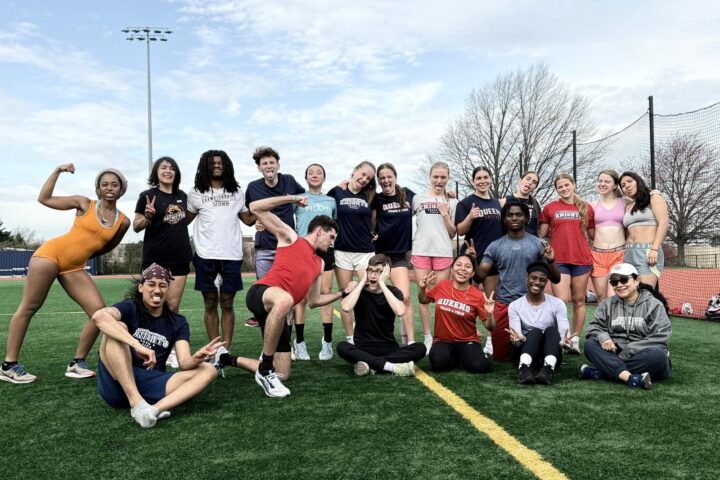



“I feel robbed of a fun final year,” said co-president of Queens College Together Representing an Organization for Philippine-Americans (QC TROPA) Darla Joanne Aquino – a senior communication sciences and disorders major—reflecting on her experience preparing for one of Student Association’s (SA) major events of the semester.
SA hosted Multicultural Night (MCN) on March 26th, bringing together student performers from various cultural organizations. Although the event concluded successfully, the weeks leading up to it posed significant challenges for performers, particularly dancers, who struggled to secure consistent rehearsal space. For Aquino and QC TROPA, the closure of the Student Union (SU) eliminated an accessible space that allowed members to practice between classes in the hallways near their clubroom.
Because of challenges in finding alternative rehearsal spaces, TROPA forwent their dance performance and opted for vocal performances instead. Aquino said access to dance studios on campus remains unclear, and off-campus options are often expensive and difficult to coordinate around student schedules.
President and social media manager of the K-pop club (KPOP at QC) Alanis Bonar, a senior advertising major, said similar issues affected her group’s preparation. While they initially used the dance studio, Room 313 in Fitzgerald Gymnasium, a sudden loss of access forced them to modify their performance. To prioritize members available for off-campus rehearsals four members, including Bonar, were unable to participate.
When Bonar attempted to reserve Room 313, her requests through directed channels went unanswered. “I submitted over five reservation requests. However, the person in charge of club event requests never got back to us, and completely left us in the dark—for months. We watched the dates requested pass,” she said.
In response, Vice President for Student Affairs and Strategic Enrollment Initiatives Jennifer Jarvis and Facility Events Coordinator for QC Athletics & Recreation Shalini Jonas said that access to Room 313 is managed through the Office of Student Development and Leadership (OSDL) and is limited to registered student organizations.
They added that reservations must follow an official process and are granted on a first-come, first-served basis because the space is shared among classes, the Athletics Department, and external rentals. The administrators also noted that at the time of its request, KPOP at QC had not completed the required annual training to reserve the space.
Social media assistant for KPOP at QC Jada Chico—a sophomore advertising major—said that when she last attempted to use the studio on March 19, it was filled with boxes and used as storage. The administration noted that this is because Room 313 is open for external rentals, which includes using the room as a holding space. Chico later learned that an alternative space in Rathaus Hall was made available, but only in three limited time slots of one-and-a-half hours during the week of MCN.
Students said these issues go beyond inconvenience and affect the overall campus experience – especially for student leaders like Bonar, who puts in time and labor to uphold her community.
“Students have told me that they chose QC because of the K-Pop Club’s social media presence and what we’ve represented. When student life systems fail to support us, it doesn’t just affect us, but the college as a whole. It weakens the community on campus,” said Bonar, who had to cancel multiple events this semester because materials were not ordered on time.
Although students said they were proud of their performances, many felt the process leading up to it overshadowed what should have been a celebratory experience. Seniors like Aquino and Bonar missed an opportunity to perform with their club members, marking an unsatisfying conclusion to the last MCN they attended as QC students and club leaders.
Club leaders said this experience underscored a larger issue: campus resources are not keeping pace with student needs. Limited access to rehearsal space reflects ongoing gaps in student organization support, an issue Aquino said is already impacting student engagement in their club. “It is truly depressing that even underclassmen are being robbed of this experience — it’s affecting our retention rate and attendance,” she added.